
Composting for delight
A guest post and love letter to compost by Cassandra Marketos, author of "Compost After Reading."


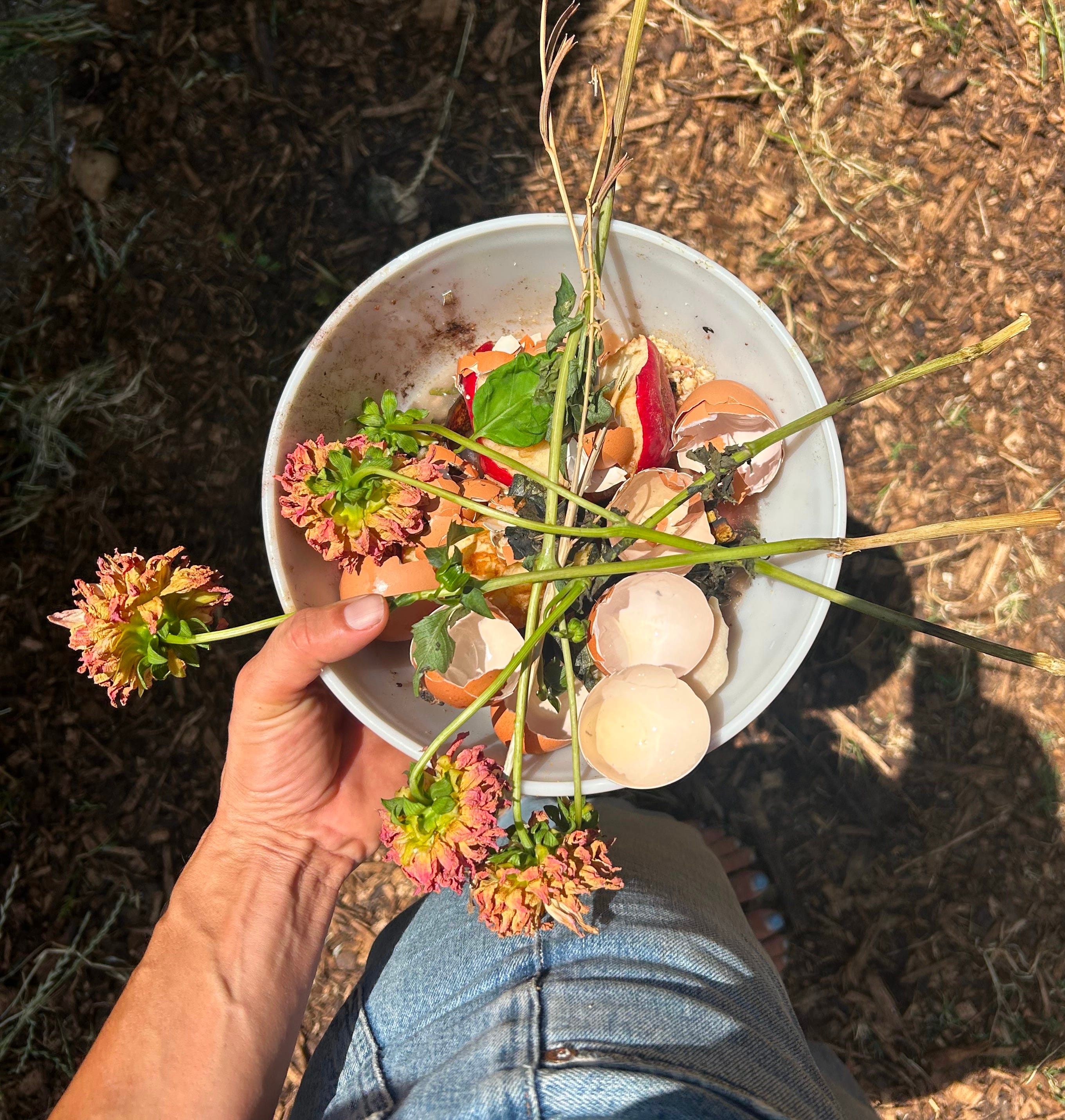
Professional composter Cassandra Marketos’s new book “Compost After Reading” has a very fun backstory: it started as a handmade zine that Marketos passed out to students of her composting workshops, morphed into a booklet printed by an indie press, and eventually got picked up by Timber Press, an imprint of Hachette, after which it made its way into the hands of eager readers like me. The book is largely an easygoing, no-fuss how-to guide for managing your own compost — the kind of guide that really makes you feel like you could figure out composting yourself — with a healthy sprinkling of compost history and gorgeous illustrations thrown in. Reading it made me itch to manage a pile on my own.
For now, as an apartment-dweller without my own green space, I’m settling for continuing to bring my food scraps to our building’s brown bin. But if you, like me, are enamored by compost, then I think you might enjoy Marketos’s work. Below, find her guest post for The Unwrinkling Roundup, and consider buying her beautiful book.
I love all my composts. I work with compost professionally, so I have five of them, which I am aware is more than most people. Each pile is technically the same, composed of the same basic ingredients and representative of the same basic process, but at the same time all of them are absolutely and totally different. Some are hot and some are cool. Some break down quickly, while others are slow. Some are teeming with worms, while others have become the preferential hiding spots for various insects and grubs. Some live in community gardens, others in my own backyard, and one even lives in a friend’s self-described “art” garden, where it’s currently at work decomposing an American flag.


The parts that are the same are simple. My “greens” come from food waste and my “browns” come from a mish-mash of brown-ish materials that circulate through my daily life, cardboard boxes and paper bags, paper towels, wood shavings from a carpenter friend, and mulch from the free mulch piles at a park near my house. These components are added to each pile in a ratio of roughly one part greens to two parts brown, then kept moist and aerated. This is where the differences begin.
My first, and oldest, compost is a traditional 3-bin system composed of three, same-sized bins attached in a row. This one can reach temperatures in excess of 165°F, the result of energy produced by microbes as they break materials down inside the heap. This pile is quick and efficient, turned once a week, and can create finished compost about every two months. My second pile is one I call the “lazy” pile. It’s a loose heap of organic debris, secured beneath some chicken wire with a set of bricks. I turn it every month or so, although sometimes I forget, and it can take almost a year to produce properly finished compost. Whatever it lacks for speed, though, it makes up for in overall liveliness. Over the years, I’ve found every imaginable creature within its woody folds, including worms, beetles, pill bugs, small frogs and even once a single, slender salamander, who has no lungs and respires through the skin.
Composts three, four, and five are just holes. I made each one by digging a few feet deep, throwing in some food waste, and covering it back up again. Compost holes are a handy tool for soil improvement. As buried food waste breaks down, its byproducts build biology in the surrounding earth, activating plant life and attracting beneficial insects. I admittedly have a soft spot for holes, which require zero maintenance and yet work as if by magic. One day I’ll toss in food scraps, and within a week or so they will have completely disappeared, leaving behind only rich, dark earth. I rotate holes around my yard, contributing my kitchen detritus in hap-hazard bursts, then watch, month after month, as the soil softens and becomes more fertile, yielding green shoots where before was only blank, hardpan dirt.
Any of these piles are given to change rapidly if it rains, in a heatwave, or if the days succumb to a prolonged, moody fog. Their rates of decomposition speed up, and then slow down. They withstand neglect, and flourish with attention. I love the way they all vacillate between sameness and distinction, and I take childish delight in observing their unique and specific behaviors across all the years that I’ve maintained them.


This delight, it may surprise some to know, is actually the principle reason I love to compost. Sure, there is also the stuff about it being good for the environment and useful in the garden, but it’s really the delight that keeps me going. In fact, I might cite “delight” as one of the most under-recognized reasons anyone should compost. Many people I know aspire to compost because they have the sense that it’s “good,” but I would make the case that it’s actually just fun. It’s fun to be messy, to be physical and work up a sweat, to see and explore the mysterious inner-workings of the heap, and to witness yourself as an agent of such profound and generative transformation. Compost may be one of the few venues where such minor attentions can offer so much pleasure, and so much potential, regardless if you have one pile or (like me) way too many.
What a gift, what fun it can be.
For more from Marketos, buy her book, subscribe to her newsletter — I recommend starting with this piece on how she makes “microbe shirts,” essentially using fungi and bacteria to tie dye T-shirts in compost(!) — and check out her website.
For more of my own reporting on compost, check out this piece on electric “composters” (which, spoiler alert, do not produce compost), where the food scraps your city collects may really be going, and the present and past of garbage politics in New York.
Back with a traditional post and poem soon. Until then, rot on,
Whitney
 | A guest post by
|
This reminds me I need to add some browns to my compost pile.. I just keep dumping the kitchen pail on so the green layer is certainly too deep. I’m a new outdoor composter after living in an apartment and using one of those foodcyclers that dehydrates & crushes food waste into a compost-like substance. I made a bin at our new house will old pallets and am trying my hand at real composting for the first time. Will have to check out the book!