
Protesting is not terrorism
The US government is lying about the people who want to stop ICE. In criminalizing dissent, this administration is pulling from a very old playbook.

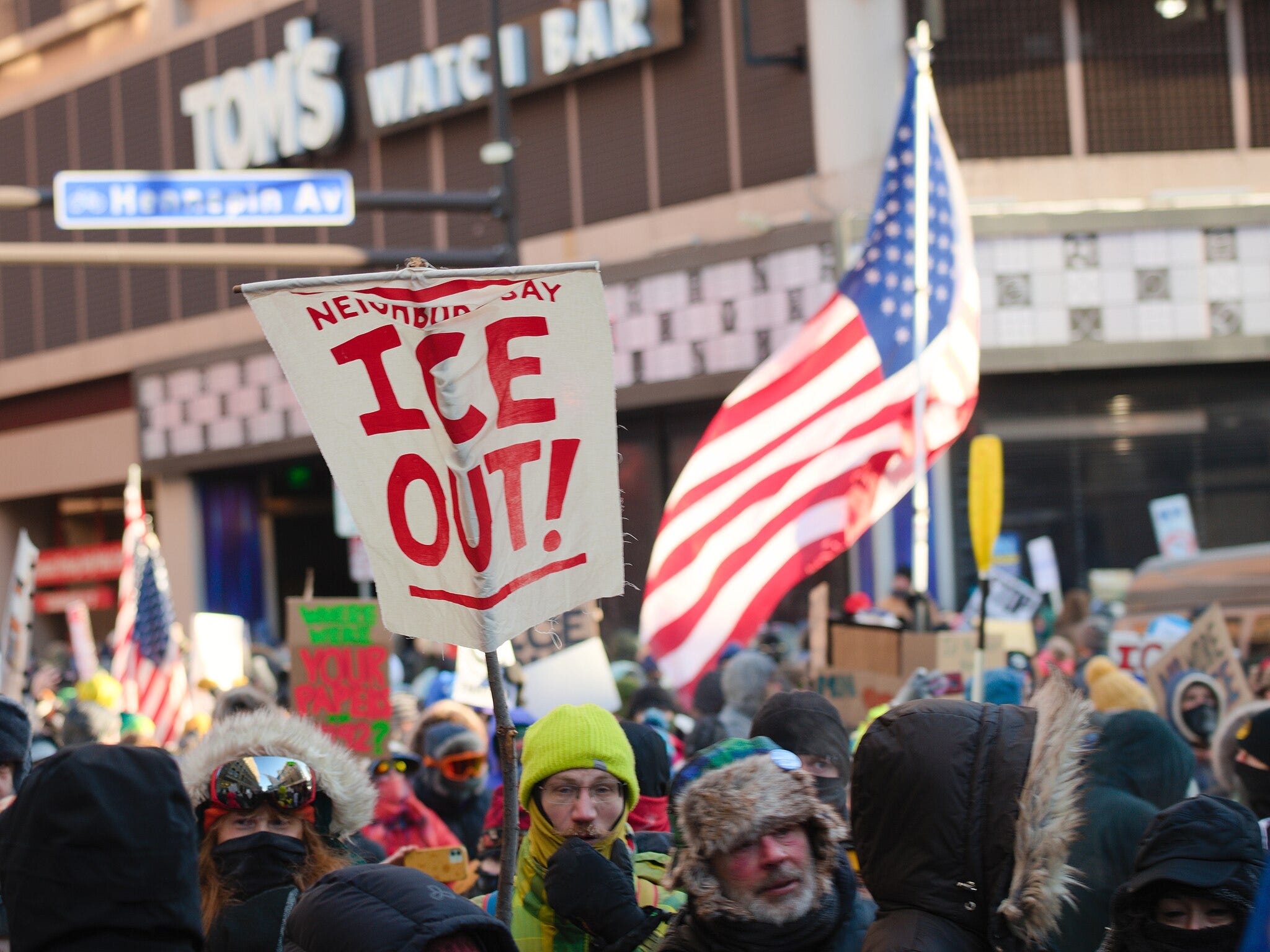
When federal immigration agents shot and killed ICU nurse Alex Pretti in Minneapolis in January, homeland security secretary Kristi Noem wasted no time claiming to the press, without credible evidence, that Pretti had been engaged in “domestic terrorism.”
Though the administration seems to be trying to soften that initial response after fierce backlash, it’s an accusation that members of the Trump administration have been leveling at wide swaths of people beyond Pretti – including Renee Nicole Good, another Minnesotan killed by Immigration and Customs Enforcement (ICE) agents two and a half weeks prior, and Marimar Martinez, who survived being shot by ICE agents in Chicago in October – as part of an ongoing strategy to criminalize dissent.
Though the hasty labeling of anyone who records or protests ICE a “domestic terrorist” has become quite brazen under the second Trump administration, the criminalization of protest and dissent in the US is nothing new – in fact, it’s as old as the country itself.
In my latest piece for the Guardian, which you can read in full here, I dug into the US’s history of criminalizing protest. Here’s a few things that stood out from this reporting:
Anti-protest bills proliferated around the country under both the Trump and Biden administrations: 29 anti-protest bills passed during Trump’s first term; 25 passed under Biden’s. These bills often pop up in the wake of prominent protest movements: think BLM, pro-Palestine student encampments, climate marches.
US government attempts to squash protest of course go back much further than that: think of Civil Rights leaders, who were regularly surveilled and jailed. If people see this moment as totally unprecedented, it might be because of the demographic being visibly affected. “What had been happening to immigrants and to African Americans … is now happening across the board to middle-class white people,” Gloria J Browne-Marshall, a professor of constitutional law at John Jay College of Criminal Justice (CUNY) and author of A Protest History of the United States, told me.
That recognition shouldn’t undermine how seriously we take this criminalization. I asked Nick Estes, a historian at the University of Minnesota and enrolled member of the Lower Brule Sioux Tribe who has written and co-edited multiple books on the Standing Rock protests against the Dakota Access pipeline, how he thinks about this. Estes told me he sees this current wave of criminalization of protest or legal observation of ICE activities as “a war on solidarity.” “White supremacy is meant to control white people first and foremost,” he said. “So if they’re not complying with the status quo, and they’re trying to defend immigrant neighbors, I see this as retaliation [against them for that].”
He pointed to Jessica Reznicek, a Catholic Worker and climate activist who was sentenced to eight years in prison, fined $3m and labeled a domestic terrorist in 2021 for damaging the Dakota Access pipeline using a pipe welder (no people were harmed). Meanwhile, “no January 6 protester got terrorism enhancement charges or sentencing”, Estes said, despite multiple fatalities resulting from the attack on the US Capitol. “I think that largely has to do with the fact that [Reznicek] was in alliance with Indigenous water protectors.”
So where do we go from here as a country? Though the risks are high, continuing to show up — to protest, to document what ICE is doing — is crucial, Paul Sullivan from ACLU Minnesota told me. Browne-Marshall suggested that today’s organizers study the strategies of their forebears in the anti-Vietnam war and civil rights movements to learn what works, including tactics like pressuring corporations to stop cooperating with federal agents. In the longer term, Sullivan noted that it will be important to fight the securitization that the US government has been ramping up since 9/11 under the banner of anti-terrorism that allows for such easy and widespread surveillance of US citizens and everyone who sets foot in the country. Many others are calling for the US to abolish ICE.
What’s helpful to remember is that in the meantime, people are continuing to show up for each other. Some in Minnesota are scared, yes, but many are more activated than ever. Sullivan told me stories of ICE officers pulling up across from a cafe and 90% of the people inside coming out to shout at them and blow whistles. “It’s really become something that the community has coalesced around, and that is that determination to oppose the regime for what they’re doing,” they said.
I’ll leave you with the poem “Robben Island” by Pamela Sneed. Sometimes it helps to look at the victories that have been won elsewhere.
Here’s to finding the antidote,
Whitney